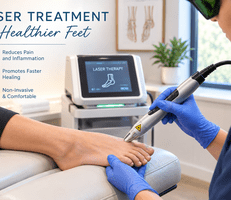
Pain Laser Treatment
-

- Tweet
- Share


Ankle & Foot Centers of Georgia
Podiatric Surgeons and Foot & Ankle Specialists located in Marietta, GA
Foot and ankle pain can affect nearly every part of daily life. From the first steps out of bed in the morning to walking, exercising, and standing at work, persistent discomfort can make even routine activities challenging.
At Ankle & Foot Centers of Marietta Georgia, Dr. Ryan Goldfine and Dr. Shaynah Goldfine, provide comprehensive care for a variety of foot and ankle conditions. Modern podiatry offers several options for managing pain, and advanced therapeutic laser technology may be an option for appropriately selected patients.
One technology worth exploring is the REMY Class IV therapeutic laser, a high-powered laser system designed for specific podiatric and therapeutic applications.
Advanced Laser Therapy for Foot Pain: How Dr. Goldfine Uses the REMY Class IV Laser
Advanced Laser Therapy for Foot Pain: How Dr. Goldfine Uses the REMY Class IV Laser
Foot and ankle pain can affect nearly every part of daily life. From the first steps out of bed in the morning to walking, exercising, and standing at work, persistent discomfort can make even routine activities challenging.
At Ankle & Foot Centers of Marietta Georgia, Dr. Ryan Goldfine and Dr. Shaynah Goldfine, provide comprehensive care for a variety of foot and ankle conditions. Modern podiatry offers several options for managing pain, and advanced therapeutic laser technology may be an option for appropriately selected patients.
One technology worth exploring is the REMY Class IV therapeutic laser, a high-powered laser system designed for specific podiatric and therapeutic applications.
What Is the REMY Class IV Laser?
The REMY is a professional therapeutic laser system designed to deliver light energy at selected wavelengths. Its cleared indications include topical heating for the temporary relief of minor muscle and joint pain and stiffness, minor arthritis pain, and muscle spasms, as well as temporary increases in local blood circulation and muscle relaxation.
Unlike surgical lasers that cut or remove tissue, therapeutic laser treatments for musculoskeletal pain use carefully controlled energy to warm targeted tissues and provide temporary symptom relief.
The REMY platform includes dual-wavelength technology using 810 nm and 980 nm wavelengths. These wavelengths have different interactions with biological tissues, allowing clinicians to tailor treatment parameters to the intended application.
The REMY system has FDA 510(k) clearance under K190034. Importantly, this clearance applies to specified intended uses; it does not mean that every condition treated with a laser has been proven to respond to treatment.
How Can Laser Therapy Help With Foot and Ankle Pain?
Therapeutic laser treatment may be considered as part of a comprehensive care plan for selected musculoskeletal conditions.
Potential benefits include:
- Pain relief: Therapeutic heating may help ease minor muscle and joint pain and stiffness.
- Muscle relaxation: Treatment may help relax tight muscles around affected areas.
- Increased local circulation: The device's cleared indications include temporarily increasing local blood circulation.
- Support for conservative care: When appropriate, laser therapy may complement stretching, rehabilitation, footwear modifications, and other treatments.
Patient outcomes vary according to the underlying diagnosis, treatment settings, and individual response. Research on therapeutic laser treatments also varies by condition, so the benefits should not be assumed to be identical for every type of foot pain.
Why Consider the REMY Laser With Dr. Goldfine?
Choosing a laser treatment involves more than selecting a machine. An accurate diagnosis, appropriate treatment settings, knowledge of foot and ankle anatomy, and an individualized treatment plan are all important.
Dr. Goldfine's podiatric practice treats a broad range of foot and ankle problems, including plantar fasciitis, Achilles tendon conditions, sports injuries, and other causes of foot pain.
When laser therapy is appropriate, a clinician can evaluate the painful area and determine whether it is a reasonable addition to the patient's treatment plan.
The REMY system offers several practical features that may be relevant in a podiatry setting:
- Dual-Wavelength Technology
The REMY's 810 nm and 980 nm wavelengths interact differently with tissue. Having both wavelengths available gives the clinician flexibility when selecting a treatment approach.
However, wavelength selection and dosage must be matched to the condition being treated. Two wavelengths do not automatically make a device more effective than every competing system.
- High-Powered Class IV Technology
Class IV therapeutic lasers can deliver higher power than lower-powered laser systems. Depending on the device and protocol, this can allow clinicians to deliver therapeutic energy in a relatively short treatment period.
Higher power also requires careful control of treatment duration, movement, energy delivery, and tissue temperature. More power is not necessarily better for every patient or condition.
- Adjustable Treatment Modes
The REMY system offers continuous-wave and repeat-pulse operating modes. These features provide clinicians with options for adjusting how energy is delivered, according to the treatment protocol and clinical objective.
The most appropriate settings depend on the diagnosis, the treatment area, and the patient's response.
- A Compact, Practical Design
The standard REMY system is designed to be compact and portable. Its physical design may be convenient for a podiatry office that treats different areas of the foot and ankle.
Practical features such as portability, interface design, and treatment flexibility can matter to a clinic, although they do not independently establish superior clinical outcomes.
Is the REMY Better Than Other Laser Systems?
Not all therapeutic lasers are the same. Devices differ in wavelength, output power, delivery methods, operating modes, treatment protocols, and intended uses.
The REMY's combination of dual wavelengths, adjustable operating modes, and high-powered Class IV technology offers a useful set of features for a clinician considering therapeutic laser treatment.
Other professional systems may offer comparable or different capabilities, including additional wavelengths or different power configurations. The best choice depends on the clinical application, the available evidence, safety considerations, and the experience of the treating professional.
The most meaningful advantage is not simply owning a powerful laser; it is using an appropriate, properly cleared device as part of a well-designed treatment plan. There is not enough comparative evidence to claim that the REMY is universally superior to every other therapeutic laser for pain relief.
For patients, the important questions are whether laser therapy is appropriate for their specific diagnosis, what improvement is reasonably expected, and how the treatment fits with other evidence-based care.
What Conditions Might Be Evaluated for Laser Treatment?
Dr. Goldfine can evaluate the source of foot or ankle pain and discuss treatment options based on the diagnosis.
Plantar Fasciitis and Heel Pain
Pain under the heel, particularly with the first steps in the morning, is commonly associated with plantar fasciitis. Depending on the individual case, treatment may include stretching, supportive footwear, orthotics, activity modification, and other conservative therapies. Laser treatment may be discussed as an additional option where appropriate.
Achilles Tendon Discomfort
Pain or stiffness along the Achilles tendon can interfere with walking, exercise, and everyday activities. A thorough examination can help determine whether the problem is tendinopathy or another condition. Rehabilitation and progressive strengthening remain important components of care.
Muscle and Joint Pain
The REMY's cleared therapeutic indications include temporary relief of minor muscle and joint pain and stiffness, minor arthritis pain, and muscle spasms. A podiatrist can determine whether the symptoms and diagnosis fall within the device's intended use.
Other Causes of Foot Pain
Foot pain may also arise from nerve problems, stress injuries, arthritis, structural abnormalities, or circulation issues. Laser therapy is not appropriate for every cause of pain, and identifying the underlying problem is essential before treatment.
What Should Patients Expect During Treatment?
The process typically begins with a clinical evaluation to identify the cause of symptoms and determine whether laser treatment is suitable.
If recommended, the clinician selects the appropriate treatment area and settings. The laser is applied according to the device's instructions and the selected protocol. Because Class IV lasers can generate heat, patients may experience warmth during treatment, and the clinician must monitor the treatment carefully.
The number and duration of sessions depend on the diagnosis, device settings, and clinical response. Improvement is not guaranteed, and laser therapy may need to be combined with other treatments.
Appropriate laser safety precautions, including protective eyewear, are essential.
A Personalized Approach to Foot Pain Relief
Advanced technology can offer additional options for patients dealing with foot and ankle discomfort, but no single treatment is right for everyone.
Dr. Goldfine can help patients understand their diagnosis and consider whether therapeutic laser treatment belongs in their overall care plan. A combination of appropriate treatment, rehabilitation, footwear recommendations, and follow-up may be necessary to address the underlying cause of symptoms.
If foot pain is limiting your activities, consider scheduling a podiatric evaluation to discuss the available treatment options and whether laser therapy may be suitable for you.
Take the first step toward understanding your foot pain and finding a treatment plan tailored to your needs.
Medical disclaimer: This article is for educational purposes only and is not a substitute for medical advice, diagnosis, or treatment. The REMY laser's FDA-cleared indications are specific, and outcomes vary. Consult a qualified podiatrist to determine which treatments are appropriate for your condition.
Services
-
 Plantar Fasciitismore info
 -
Ingrown Toenailmore info
-
Bunionsmore info
-
Achilles Tendonitismore info
-
Wartsmore info
-
Hammer Toemore info
-
Orthoticsmore info
-
Ankle and Foot Traumamore info
-
Ankle Fracturemore info
-
Cornsmore info
-
Diabetic Foot Caremore info
-
Lapiplastymore info
-
Morton's Neuromamore info
-
Wound Caremore info
-
Toenail Fungusmore info
-
Foot Ulcersmore info
-
Ankle Sprain and Foot Sprainmore info
-
Heel Painmore info
-
Posterior Tibial Tendon Dysfunctionmore info
-
Athlete's Footmore info
-
Arthritismore info
-
Callusesmore info
-
Platelet Rich Plasma (PRP)more info
-
Onyfix for Ingrown Toenailsmore info
-
Stem Cell Injectionmore info
-
Liposana Fat Pad Restorationmore info
-
Pain Laser Treatmentmore info
-
Laser Toenail Fungus Treatmentmore info